
 448
448 Jan. 4, 2026
When NVIDIA CEO Jensen Huang defined energy as the foundation of AI’s “five-layer cake,” and when U.S. data center projects began turning into “digital ghost towns” due to grid constraints, a global energy race—driven by computing power—quietly began.
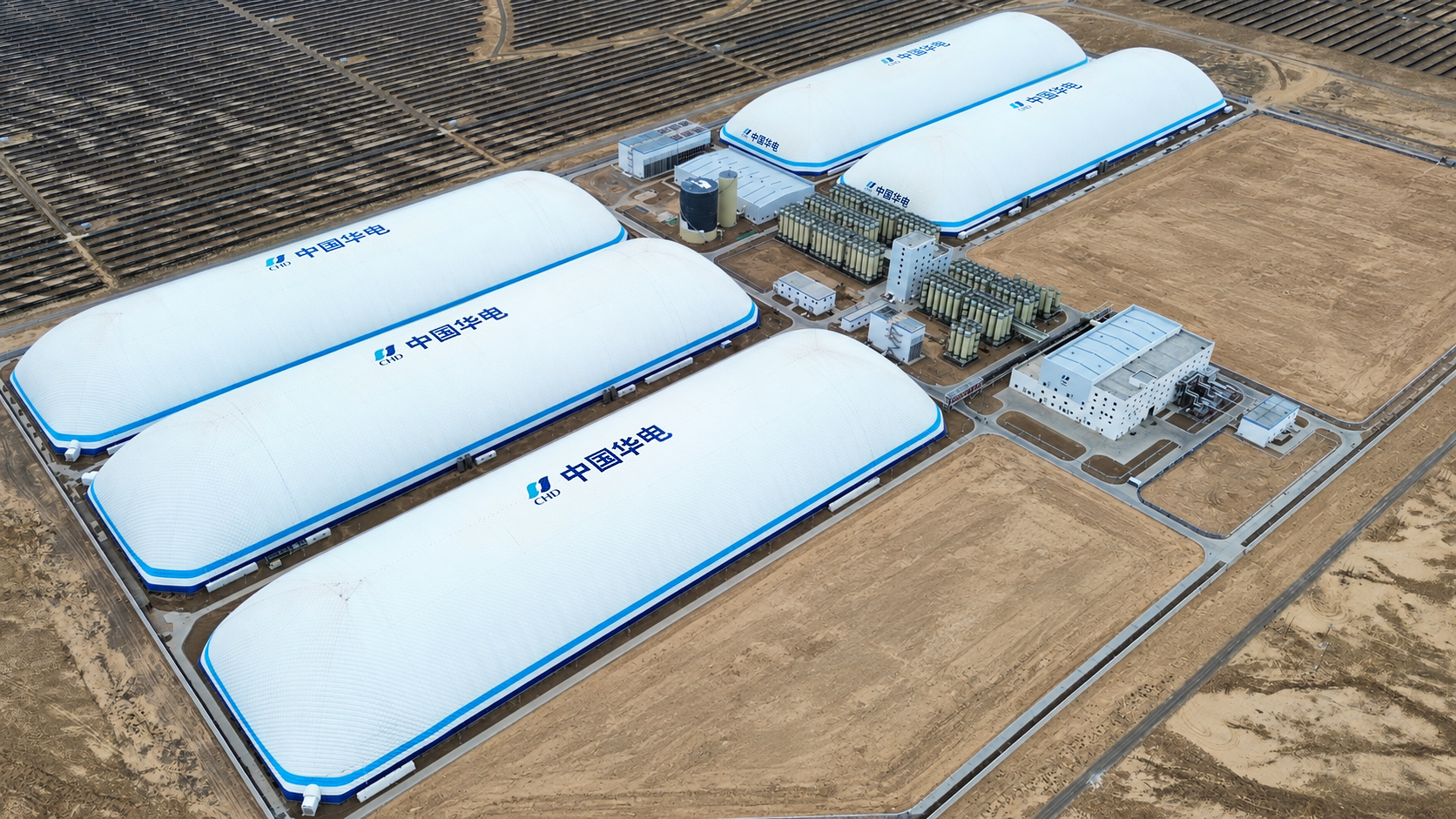
In the energy storage arena, Exax Energy has charted a distinct path. With its globally leading compressed CO2 (CO₂) energy storage system, the company offers a robust, system-level solution that directly addresses the “triangle dilemma” faced by AI data centers (AIDCs): speed, reliability, and economics.
This is not merely an answer to whether power is available, but a redefinition of what kind of power should be used.
A Disruptive Principle: From “Battery Arrays” to “Energy Gas Storage Facility”
Unlike mainstream electrochemical storage technologies such as lithium-ion and sodium-ion batteries, Exax Energy’s CCES system lies in physical energy storage.
Its core working principle is to utilize surplus electricity generated from renewable energy sources, drive compressor to compress gaseous CO2 into a liquid state, and store it in high-pressure vessels, thereby completing the energy conversion from electrical energy to pressure potential energy plus thermal energy.
During periods of power shortage or peak demand, the high-pressure CO2 is released to drive turbine, converting the stored energy back into stable electrical energy for output.
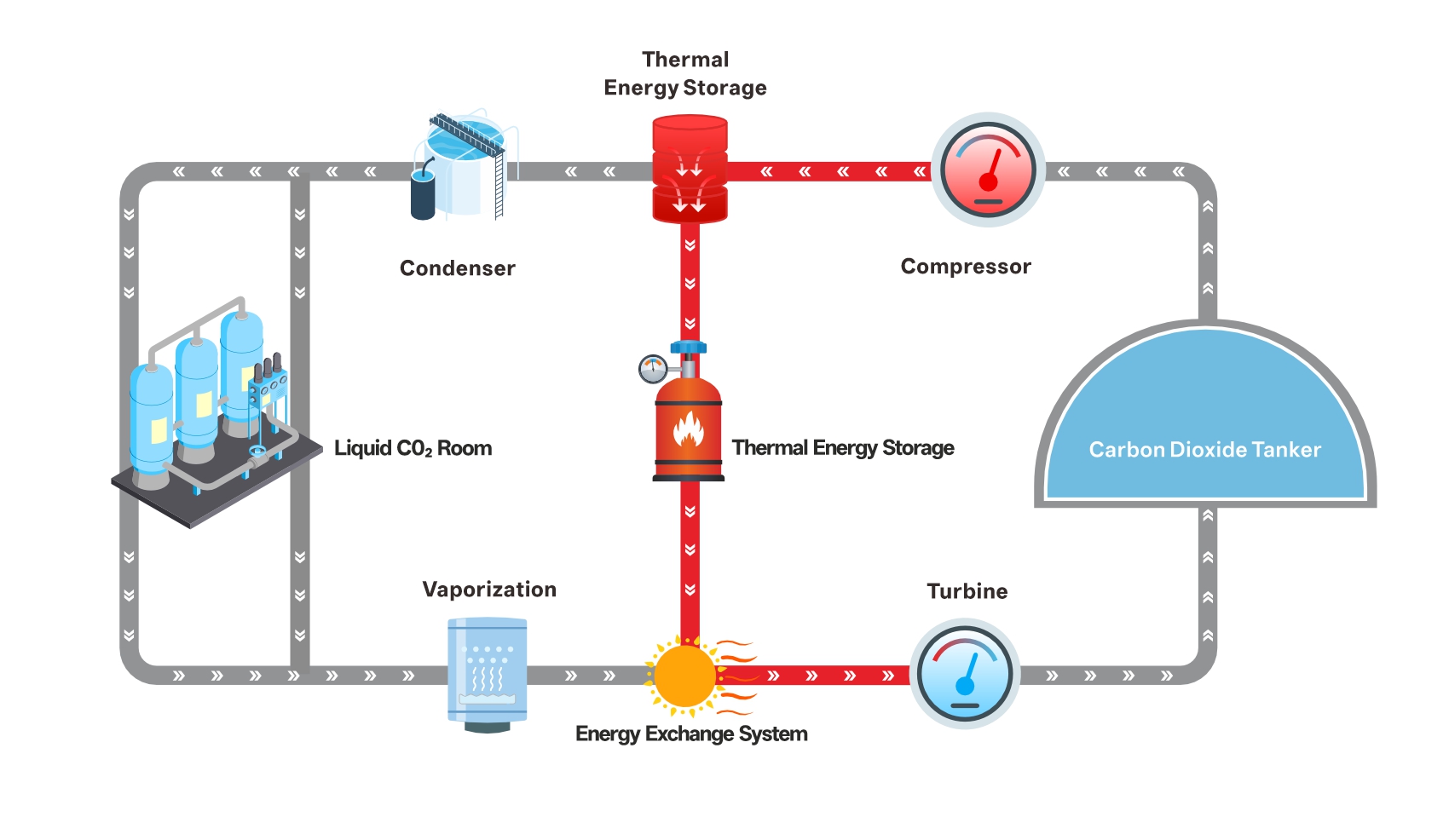
The system achieves a unique triple "heat-electricity-cooling" synergy: during the energy release and power generation process, the temperature of the CO2 working mass can drop below 23℃ after expansion, which can directly or via a heat exchange system provide high-efficiency and free cooling for data centers to meet their massive cooling demand.
Meanwhile, the waste heat generated during the compression process can be recovered and used for domestic heating or hot water supply, turning the biggest cost burden of AIDC—heat dissipation—into an asset that improves the overall energy efficiency of the system.
This technological pathway delivers three fundamental advantages in addressing the AIDC power shortage crisis:
- Intrinsic Safety: Eliminating AIDC’s Biggest Concern
Data centers, especially AIDCs housing core AI training workloads, prioritize continuous operation and safety above all else. Yet the risk of fire and explosion associated with chemical batteries remains a sword of Damocles hanging over their operations.
As an energy storage medium, CO₂ is non-toxic, non-flammable and chemically stable. It completely eradicates the risk of thermal runaway, while its intrinsic safety clears the biggest barrier to high-density, large-scale deployment at or adjacent to data centers.
- Long-Duration and Scalability: Matching Grid-Scale Gaps
The power deficit of AIDCs is of a grid-scale magnitude. The CO₂ energy storage system developed by Exax achieves a single-unit power capacity of up to 100 MW, with its storage duration flexibly adjustable (ranging from 4 to 24 hours or even longer).
It can effectively smooth out intra-day and multi-day fluctuations in wind and solar power generation, converting unstable green electricity into a reliable, continuous and stable baseload power source—truly realizing the vision of “green power as primary power”.
- Exceptional Lifespan & Cost-Efficiency: Aiming at the Economic Bottom Line
AIDCs are extremely sensitive to total life cycle cost (LCC). The core components of the compressed CO₂ energy storage system (compressors, turbines, and storage vessels) boast a service life of 30 years or more, far exceeding the 10–15 year lifespan of electrochemical energy storage systems.
Its levelized cost of storage (LCOS) drops sharply as scale expands and duration extends. For long-duration applications (e.g., over 8 hours), its LCC has become competitive with pumped hydro storage, moving steadily toward the goal of “affordable energy” championed by Jensen Huang.

Solving the “Triangle Dilemma”: A System-Level Deconstruction
Faced with the AIDC power supply triangle dilemma, Exax Energy’s CO₂ energy storage solution demonstrates comprehensive system-breaking capability:
• Accelerating Infrastructure and Expansion
Exax leverages a modular prefabrication design to slash project construction timelines by 50%. Core components of the energy storage system are fully prefabricated in modular form at factories, with on-site work limited primarily to assembly and interconnection. The construction cycle for a 100 MW-scale project can be compressed to 12–18 months, perfectly aligning with the construction schedule of AIDCs. This makes it the fastest power supplementation solution to break the bottleneck of “waiting for power to match computing capacity”.
• Balancing “Load Monsters” and Fragile Grids
CCES can provide rotational inertia, acting as shock absorbers for the grid. AIDC power surges place enormous stress on power systems. With rapid power regulation capability, CO₂ storage can quickly absorb or release power, smooth extreme AI load fluctuations, and provide valuable inertia support—enhancing grid frequency stability and transforming “load disasters” into dispatchable resources.
• Breaking the Green–Cost Trade-off
Exax Energy’s CCES system unifies zero-carbon cycles with low-cost storage. The technology itself produces no carbon emissions and efficiently absorbs renewable energy. More importantly, its long lifespan, low losses, and minimal maintenance requirements—combined with ongoing technological advancement—are expected to push the cost per stored kilowatt-hour of large-scale long-duration storage into a highly competitive range, eliminating the “green premium” and enabling AIDCs to use power that is both clean and affordable.

Scenario Implementation: Building an “Exclusive Energy Base” for AIDCs
Exax’s CCES solutions can be flexibly deployed at three critical nodes, forming a multi-layered safeguard system:
Power Source Side (Generation + Parks):
Integrated with large wind and solar bases to build “renewable power + CO₂ storage” plants, generating and delivering stable, green, AI-dedicated electricity.
Grid Side (Key Nodes):
Deployed at transmission bottlenecks or near load centers as regional “power buffer pools,” relieving congestion and rapidly enabling access for new AIDC clusters.
User Side (Data Center Campuses):
Built inside or adjacent to AIDC parks, it acts as the core energy infrastructure of the park. It can not only provide an uninterruptible backup power supply (replacing diesel generators) to achieve “zero-carbon backup power”, but also participate in the park’s integrated energy management, deliver demand-side response services, and significantly reduce electricity costs.
From Technological Leadership to Ecological Co-Creation
Despite the promising prospects, as an emerging technology, large-scale deployment of carbon dioxide energy storage still faces challenges. Exax’s approach to breaking the impasse lies in transforming from a “equipment provider” to an “energy base ecosystem builder”. We will continue to deepen our expertise in core technologies and deliver energy storage projects on a larger scale and with higher efficiency.
Meanwhile, we will directly collaborate with power grid companies, data center operators, renewable energy developers, financial institutions and even policymakers to jointly drive the design of market rules, the establishment of standards and the innovation of business models.
Exax is committed to turning an emerging cutting-edge technology into a solid energy foundation that supports the exponential growth of global AI computing power.
Storing the Future for the Intelligent Era
It may not be the only solution to the power shortage plaguing data centers, yet with its unique advantages in intrinsic safety, ultra-long-duration storage, total life cycle cost efficiency and grid-friendliness, the CCES system is poised to become an indispensable component in the blueprint for building a future-oriented, highly resilient, green and cost-effective new power system and computing infrastructure.
As AI sets its course for the stars, it may well be the quiet yet powerful "carbon dioxide energy" stored in high-pressure vessels that lays its foundation. Exax’s endeavor represents nothing less than a critical breakthrough on this very path.